We just went out to get some beer. And then it happened.
Max, Ralph, and I were in Tanzania, staying out in the middle of nowhere, in a tiny village near Kilimanjaro called Uswaa, for the past two nights, at the childhood home of our guide, Kakasii. He was the last-born child and so, according to Chagga tradition, the maintenance of his mother’s home/farm was his responsibility; every one of his siblings would come here for two weeks at Christmas every year and the house sure as hell better be standing and well-stocked. Last Christmas, they slaughtered some outrageous number of animals for those gathered at the house--a dozen cows, a dozen goats, chickens, etc. Call me a city boy, but it’s hard to even estimate how much meat that is; but it sounds like A LOT.
It wasn’t Christmas, but all of Kakasii’s siblings were in town because their mother was deathly ill at the local hospital. At his insistence, we went to visit her and it was one of the most prolonged awkward moments of my life. All around me, crammed into rooms, crammed into hallways, people were ill, people were dying. Loved ones were near, dedicated doctors scurried from one patient to the next, everybody stared at the three white guys strolling through, and the same thought ran through my head in a never-ending loop--
‘Hold your breath, don’t touch anything, don’t catch anything, meningitis can be transmitted through the air, along with who knows what else. Holy shit, these poor people, so many of them might die, who knows what they have, but the worst of them will infect the best of them, they’re too close together, I’m too close...holy shit, I don’t want to be here, I don’t want to catch anything they have, holy shit, this is like asking to be taken to the best place to get the worst disease imaginable. Why did I let them take me here? And yet I know that Kakasii, quickly a good friend, wants us to be here, to meet his mother, to talk to her, to brighten her day, to help make things better. Best intentions. It would be rude to ask to leave. But it would be worse to get meningitis or leprosy or whatever the hell else they’re cultivating in here...’I met his mother, held her hand, spoke to her in elementary Swahili and simple English, told her that I hoped she got better, wished for probably the first time that I had the crutch of religion to fall back onto, to resort to in this exceedingly uncomfortable situation. It would be so easy to say, “My prayers are with you...” or something like that, and yet I could not do it, could not say it, could not lie; and so my time on the hot seat was all the more blistering.
I wished I had a private audience, knowing she would not know the difference if I recited Shakespeare or read the paper, as it is with infants, but she was constantly surrounded by her daughters and the wives of her sons, who rotated shifts, one woman always by her side. The judging ears of these nearby and bilingual-enough women held me to a higher standard than the dying woman ever would have herself. Shit, what a test of faith. But I stood firm and stuck to my good-natured atheism. I have no idea what matter of useless bullshit I said, but I hope it helped.
Outside the hospital, as we waited for a few familial stragglers to say hello before visiting hours ended, we ran into one of Kakasii’s older brothers, Clemence, for the second time that day. Earlier, Kakasii had driven us by Clemence’s small chemistry shop off the main road--it was a store that, by all accounts, sold nothing but Bunsen burners, beakers, and laboratory chemicals, yet seemed to expect / rely on walk-in traffic, in the least-likely location you could ever imagine--an iPod repair shop in Antarctica would get more traffic.
You can actually research our presence there, if you wish, as the Tanzanian custom of excessive documentation was in full force at Clemence’s shop--we all had to sign a guestbook that proved we were there, even though we just popped in to say hello. The weirdest part about all the sign-in books in Tanzania was that they always asked how old you were and what your occupation was; why do these things matter? Later, on our trek up Kilimanjaro, we decided to get creative with our occupations at each camp check-in: ghost, wizard, blowhard, etc. Nobody noticed.
On our way back from the hospital--well, out of the way, really--we stopped off to trade in some of our delightfully-empty beer bottles for more-delightful full ones. The closest bar/store to the family farm happened to be right across the street from Clemence’s house, so, naturally, we had to stop in and say hello.
Well, it wasn’t his house, exactly--he and his family lived in a supposedly-enormous house in the former capital and largest city, Dar Es Salaam, an 8-hour drive away--this was his Christmas house. Like all seven of his siblings, ever since he left it, Clemence returns to his childhood home in Uswaa, for two weeks a year, in December. As a man of impressive means, it did not take long for him to outgrow crashing on the couch of his little brother’s house, so he built one of his own nearby, for comfort; it was an inarguable island of luxury in a sea of poverty.
According to local standards, the Christmas house was impressive for sure; it was not made of cow shit, it had a floor, windows, doors, multiple rooms, a garage, electricity, a houseboy we were never introduced to...and this was only his Christmas house. Evidently, as hinted at earlier in our trip, Kakasii and his family were some of the richest people around. Kakasii and Clemence are two of eight children of one of their father’s four wives; their grandfather had nine wives and pretty much ran the entire village of Uswaa; nearly everybody we met in Uswaa was related to Kakasii by blood or marriage.

After insisting we have a drink before we leave his house, as is Chagga custom, and then also insisting that he would only have dinner at his own brother’s house if we invited him, Clemence prepared to depart for dinner around the fire at Kakasii’s. As the houseboy scurried around, picking things up, Clemence grabbed his jacket and an oddly-shaped black shoulder bag of some kind.
“What’s that?” I asked.Without answering me, he laid the bag down and opened it up; inside was a pristine, matte-black, sawed-off shotgun. My mouth hung open. I hate guns. I never want to see one in person. I never want to be around one. I think guns are the single worst invention in the history of mankind. They bring nothing but destruction.
“I won’t use it, but since I’ll be coming home alone...”Kakasii raced over, grabbed the shotgun, emptied out what seemed to be a dozen shells, then wildly waved it around the room, pretending to be a cowboy or robber or something. Max, Ralph, and I all tried in vain to avoid having it point at us, but that wasn’t working very well, so I moved over behind Kakasii and followed him as he spun around pretending to kill imaginary bad guys, as excited as a child at Christmas. Thankfully there were no accidents.
Outside, the three of us piled into Clemence’s immaculate white Nissan SUV, along with Kakasii’s wife, Rosie. Clemence’s white car has a white leather interior, in rural Tanzania, one of the dustiest, dirtiest places on Earth.
“How do you keep it white?”I sat down in the back, next to Rosie, and Clemence thrust the sawed-off shotgun between my legs.
“I never roll the windows down--always A.C.”
“You need to hold this for me.”

I didn’t want to touch it, so it rattled around between my legs, butt on the floor, muzzle pointed at the roof, for the entire bumpy, unnecessarily-air-conditioned ride back to the village. From the driver’s seat, Clemence talked a mile a minute, asking us about Obama, about the political situation back home in general, about what the American blacks were like, etc. It was somewhat difficult to hear what Clemence was saying, though--especially in the backseat--since he was competing with the powerful lungs of Celine Dion, whose Beauty and the Beast jams were blasting out of his stereo--by choice, on CD. About halfway through the journey, in sheer disbelief at where we were and what we were doing, my brother turned to me from the front passenger seat.
“Happy 30th birthday.”His crooked smile said it all. I was not alone. This was what we came here for. This was an absolutely unpredictable, insane, beautiful moment we were sharing. This was the intoxicating reward adventure had to offer.
But adventure also has a price.
We just went out to check our email. And then it happened.

Our allotted four days in Uswaa village over, we said our goodbyes to fast friends young and old and headed back to Arusha, the big city near Kilimanjaro. Our climb was to begin in a couple days, and we had to prepare. The first step was meeting with our guide.
Kakasii’s friend Clemence (not his brother, also named Clemence) was an eminently-qualified guide up Kilimanjaro--he grew up on its slopes, had been climbing it since he was a young man, was the president of the climbing guide association, brought lawsuits against negligent/shady climbing companies, fought for pay raises for the porters--but he was also the biggest drag of our entire trip to Africa.
How could we have fallen so far from where we were last night? So far we had met so many warm, friendly people and Clemence was cold as an icebox. He was disappointed we didn’t prepare questions about the flora and fauna of the Mt. Kilimanjaro National Park. He was concerned that we didn’t bring sleeping bags and walking poles, even though our paperwork said those would be provided for us. He was worried that we did not understand how much water we should be drinking on our climb (we did). He tried to insinuate, calmly, that we were stupid and that we would die up there. It was not a good meeting. Our delicious African bubble had burst.

You see, we had been in the middle of nowhere for four days. How far in the middle of nowhere? It took Kakasii over five years to convince the local power company to allow him to pay for electric wires to be strung to his house. They had to run the cable for 1.5 miles. As soon as he left the farm, to return to his house in Arusha, somebody stole the power cable to sell for scrap across the border, in Kenya, for a penny on the dollar. So Kakasii had to re-string it and hire somebody to keep an eye on it--his houseboy, whom he never introduced to us, who might as well have been a ghost, who was evidently not the father of his son, a fact Kakasii brought up to me on at least two occasions, making me wonder if he was trying to tell me that he was the father. More likely, he was just proud to have the gossip at his disposal, proud that nobody could say that about him (as far as he knows), proud that he is more of a man than his houseboy.
Kakasii also revealed two other interesting tidbits during our time in Uswaa. Our first day there, while giving us a tour of the village, surprising all matter of unprepared locals with a trio of unexpected white men popping forth from the bushes, he casually mentioned that he had personally beaten a man to death for stealing a chicken from a neighbor.
“The guy who lived here in this house was a thief. Real bad thief. Real bad. So, one night, I got some peoples together, and we wait. And he sneak out and went to the neighbor’s to steal a chicken. I had a witness, and I beat him real bad. Real bad. In the morning, he was dead. Over here is the house of my brother--well, he is not my brother, but I can say he is my brother because he is very close to me...”The other revelation hit closer to home. Our good-natured and talented cook, Moussa, hadn’t been feeling well ever since we met him. Toward the end of our time together, Kakasii told us as much.
“Huh? Did he just tell us he’s a murderer?”
“Yes. Yes, he did.”
“Moussa’s not feeling well. Probably malaria.”Malaria, the omnipresent coiled cobra of whose strike we lived in constant fear, had reared its fanged head. Like a slap in the face, I suddenly realized that none of the locals were covered at all times in 100% DEET mosquito repellant; none of the locals were popping Malarone every day. I guess they just rolled the dice--and often lost.
“What?!”
Despite his apparent illness, Moussa continued to cook for us, load and unload the car for us, and sleep outside in a tent so we could be inside in beds. After we headed into Arusha to prepare for the Kilimanjaro climb, Kakasii dropped Moussa off at the hospital to be examined. Diagnosis: malaria. Presumably, Moussa spent the next 2-3 weeks nailed to a bed, under the vicious influence of the least-expensive, most-intense, hallucinogenic malaria medication available. I hope he survived.
But I digress.

Back in Arusha, the three of us said our temporary goodbyes to Clemence #2 and Kakasii--post-pre-climb meeting--and retreated upstairs to our hotel rooms. We all immediately agreed we hated Clemence and that we were no longer terribly excited about our climb. We yearned for the warmth and possibility of Uswaa. Max was tired and turned in for the night; Ralph and I both yearned for a little fresh air, a little physical activity, a little local brew, a little more venting, maybe even a little communication with loved ones very far away from all this.
Before I left the hotel, at my brother’s urging, I emptied my pockets of everything but about $10 in local currency. It was the best decision of the entire trip.
I met Ralph in the lobby, where he was asking our sweet-but-fairly-ignorant receptionist where we might be able to find internet access, since our hotel did not offer it, for some reason, despite the fact that it had one of the only elevators we saw in the entire country and was made almost entirely out of marble, and was therefore a luxury hotel aimed at business travelers, who like to use the internet. She had no idea where we could find it, but said we should take a taxi. Take a taxi to where? Hmmm...
We set off on foot and I immediately regretted it. We were headed for ‘the clocktower,’ which we both had seen several times before, but the exact location of which we were hardly certain. I was freshly showered, feeling good, feeling fit, and on alert, but as we walked the streets, I couldn’t help but feel like I had flashing lights mounted to my head, with a siren blaring:
“WHITE MAN! WHITE MAN! WHITE MAN! WHITE MAN!”In the dark-as-hell, middle-of-nowhere, 7pm Arusha night, with every single ramshackle shop closed for the evening, and bug-eyed eyeballs tracking us from every shadow, it was impossible not to feel like a target for somebody, for at least the most desperate among them.
As my initial butterflies began morphing into silent screams of “Go back! Run away! Tell Ralph we shouldn’t do this!” I heard a loud whistle. I immediately thought that it might be a signal to somebody, some kind of perverted ‘dinner bell,’ communicating to the criminals-at-large the fact that there are white tourists wandering around at night, so come and get ‘em. My eyes darted around even more than before, my fists clenched, my muscles flexed--I was ready for combat, despite how futile it usually is, especially when ambushed and outnumbered.
Ralph and I agreed we would turn left, because I thought the clocktower was in that direction, but if we got to the bridge up ahead and couldn’t see it, we would turn back. All the hairs on my body (and there are a fair amount of them--sorry, ladies) stood on end. Would we make it?
Everybody I had met in this country so far was a warm and welcoming host, yet we all know there is also a dark side to Africa. There is poverty and starvation and malcontent on a grand scale, there are wars, evil dictators, pirates...but this is all beside the point. There are areas of cities in the United States where one should not walk after dark. There are just certain places you should not be, if you can help it. And that’s exactly where we were.
 (photo courtesy of www.smh.com.au)
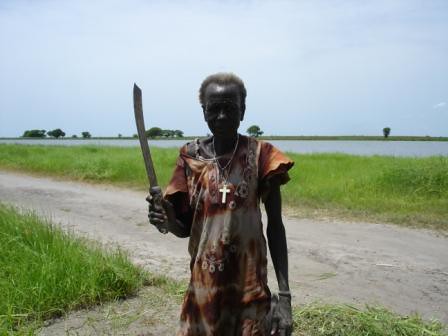
 I sensed them coming before I should have; they were fast, it was dark, and we were easy prey. But I did. I don’t know how--Spideysense? I turned to see three guys running at Ralph with pangas (local version of a machete) raised above their heads. I immediately turned to run, knowing that is always the best move if you think of it in time, being a recent veteran of this situation, sadly.
“Ralph! Run! Run!”As I ran away, I saw two guys that had been heading for me give up and change direction--they joined the others and swarmed Ralph instead. He didn’t stand a chance.
“Run! Ralph! Run! Run!”I didn’t know what else to do. I figured he could still get away. I figured the attackers were just bluffing and all he needed to do was run and he would be okay.
It’s always easy to assume that, to say that, but when you’re actually there, in the moment, staring at some creepy, breathless dude with a blade trained on your face, it makes way more sense to just stand still and let him take what he wants. All that runs through your head is the advice you always hear from people who’ve been through it before:
“Whatever you have on you is not worth your life. Whatever you have on you is replaceable, don’t fight back, don’t be a hero, that’s how people wind up being dead for no good reason.”And it’s true. It very well could be the case that this guy is just figuring you’ll shit your pants and let him have his way, and he never planned on using the weapon, but it’s equally as likely that he is a deranged lunatic who would just as soon slice your head off as look at you. It could be a guy on a power trip, a guy with something to prove. How does one determine how crazy somebody is by looking at them? How does one measure at a glance the desperation and fury in a man’s soul?
Now imagine there are five of them. You’re in the middle of darkest Africa. And they all have rusty machetes raised above your head, shouting in broken English to give them your money.
I stood about twenty-five feet away, ignored, watching it all happen. Ralph stood in the middle of the crowd, calmly saying “No, no. Come on. No...” as the five assailants picked at his pockets. I knew I couldn’t leave him here, I couldn’t run away, but what could I do to help? What should I do?
I walked back over toward Ralph and two machete-wielding assholes quickly converged on me. Just like Ralph, I was strangely calm. I was crossing my fingers they were not the type to actually use those machetes and glad to only have $10 on me, tucked away in a secret zipper pocket of my pants. I raised my hands like a police negotiator walking in to a bank heist.
“Give us your money!”I watched over their shoulders as Ralph tumbled into the street with one of the other attackers. I was confused--why didn’t they just take what he had and run away? What was this guy going to do to him? I didn’t even want to consider the possibilities.
“I don’t have any money.”
“Give us your money!”
“I don’t have any!”
Traffic stopped on the somewhat congested thoroughfare--rush-hour traffic, I suppose--as this guy sat astride Ralph in the middle of the street. One of the guys accosting me at the time grew frustrated with my tack, yanked out my right pants pocket, and sliced it out with his panga. Then the guys all ran away.
I figured I might only have one shot at this guy on top of Ralph, so I’d better make it count. I ran as fast as I could, into the street, straight at the guy, leapt off the ground, raised a knee, and smashed into his ribs. I knocked him to the ground. His machete went flying.
I went over to see if Ralph was okay. He was. He got to his feet and we were both standing in the middle of the street, cars honking at us. We turned to see a crowd of people running right for us and froze in fear.
Luckily, they were not coming to finish the job; they were the good guys. Well, actually, as it turned out they were coming to finish the job--our job.
Not thirty seconds after Ralph’s attacker fell to the pavement, a total stranger was booting him in the face with abandon. Then another went after his ribs. One by one, a mob of people--regular people, the Arusha version of you and I, commuters waiting for the bus home, students, etc--ran over and stomped on this guy. He cowered from the blows, reacted to the blows, but did not avoid them, did not run from them. Was he too weak? Was he too injured from the first one? Did he simply know that at this point his fate was inevitable? Was he doing penance? Was he surrendering to death?
Several of the bystanders ran across the street, grabbed enormous railroad-tie-sized pieces of wood and beat him til they broke.
I scrambled to see what of our possessions we could recover--I found my pen, oddly the most valuable thing I owned at the time--next to my passport, and Ralph’s White Sox hat, but that was it; my brother’s Tanzania guidebook was gone. I felt really bad about that; I know how much he loved it.
Ralph turned to me with a look of despair.
“They got my passport. And my credit cards. And my license, and my cash, and my checkbook...they got everything. Everything!”I checked the back pocket of the guy being beaten and found a wallet. I opened it. Nothing whatsoever inside. Empty.
“What the fuck? Why did you have all that on you?”
“I don’t know!”
Two guys approached Ralph and I and asked us, in English, if the attackers got our passports. We told him they got Ralph’s. They checked the beaten guy’s front pocket and found his stash--amazingly, Ralph recovered his passport, credit cards, and driver’s license. The guy with his checkbook (useless here) and cash ($50) got away.
In a surreal detachment from the scene playing out before us, from what had just happened to us, we felt strangely fine--violated, for sure, but, at the same time, lucky that things didn’t turn out as bad as they could have. I was now missing a pocket and we were down $60--could have been much worse.
And then we realized the mob was planning to beat this guy to death in the street. They were not stopping. It was not a beating to teach him a lesson, it was a beating to teach others a lesson, to teach others that if you steal they will show you no mercy, they will kill you with their hands and feet and anything else nearby.
And so our consciences thrust us into the awkward--and potentially dangerous--situation of trying to rescue our attacker. We shouted at the crowd to stop, told them it would do no good to kill him, that it would solve nothing, and tried to shoo them away. We even got between them and their victim.
It worked about as well as I could have hoped, with only the occasional strike venturing through the white-man’s invisible, waved-hand force-field.
Ralph told the two guys who knew English and helped us earlier that he wanted to talk to the cops. They told him the cops would not come, but Ralph still wanted to wait for them. Since I didn’t necessarily want to start the scary journey back to the hotel just yet, I didn’t mind sticking around for a bit, surrounded by people, waiting; but it was not like I really wanted to stay there, either. Ideally we would have been teleported back to our beds at the hotel.
At some point, a security vehicle--think Tanzanian Rent-A-Cop--pulled up. I had seen the same vehicle drive by twice before and not stop, but for some reason it did this time. Perhaps somebody flagged them down and they were bored enough to see what was the matter.
At any rate, they came over and dragged the unconscious, beaten criminal into the back of their pick-up SUV. Turns out one of the guys who spoke to us in English earlier had also been robbed by these guys, not long before us, and he wanted to take this one to the station and press charges, file a claim.
“If you want to talk to the cops, you have to come with us.”Ralph and I looked at each other, unsure.
“Is this cool?” Ralph asked.I didn’t think it was a great idea, but I also couldn’t think of a better one and I figured it would be one more leg of the adventure, so why not? At least we were together, at least we were not injured, at least we were not alone, at least we didn’t have to walk the gauntlet back to the hotel.
“Sure.”
As we sped through the pitch-black streets, Ralph shouted over the wind at our newfound friend, who stood up in the back, holding onto the rollbar, clutching aloft the assailant’s rusted panga, planning to submit it as evidence.
“Where’s the police station?”Ralph was shouting, impatient, wanting information. I started to get freaked out--where were we going? Where would we end up? How did we know we were being taken to a police station? What would the police be like?
“Close.”
“How far?”
“Not far.”
“How far?!”
As an unstoppable chill cruised up my spine, I suddenly felt a hand on my knee.
I looked down to see the no-longer-unconscious attacker, covered in blood, grabbing at my knee, mumbling something in Swahili. I instantly realized I did not want this guy’s blood on me, because of what may or may not be in it and because this was my only pair of pants--and it already had a fucking pocket sliced out, thanks to his friends.
I booted him in the face.
“Get the fuck off me! Get off me!”I booted him a few more times before he got the hint. I think he went unconscious again. We rolled into the parking lot of the police station and everybody hopped out.
The Rent-A-Cops dragged the assailant’s body inside. We followed. They deposited him underneath a flip-up counter-top, like you might see at an old coffee shop or library checkout counter. A large police officer immediately walked over, flipped up the counter, and booted the criminal in the face. He then dragged him by the collar and propped him up against the back wall, about twenty feet from where we were standing.
Another police officer passed through the area on the other side of the counter and gave our assailant a boot in the ribs, us a thumbs-up. I did not return the gesture. Where were all these guys when we needed them? A vicious brawl in the middle of the street at 7:30pm, and not a cop to be found? And yet here they were plentiful as pollen.
Another officer smiled at us as he kicked the guy.
“Good job!”We didn’t know how to respond. We didn’t.
The police station was an insanely strange place, to say the least. It felt like the customer counter at an electronics wholesaler; you know they have a huge warehouse in back, they have everything you could ever want in stock, and plenty more you don’t want, but you are only granted access to a tiny room staffed by four or five guys that come and go as they please, bringing you only what you specifically ask for after perusing their 9000-page catalog.
This particular warehouse just happened to have jail cells behind it that looked like they belonged in the Count of Monte Cristo. The history in here was sickening to think about.
The scrawny young deskbound officer assigned to our case started asking us questions about what happened and quickly gravitated to the other victim who rode with us in the Rent-A-Cop SUV, since he spoke Swahili. This being the case, he got to tell his story first. I zoned out and watched the desk clerk at work.
Rather than pull out a form of some kind (Victim’s Report, Witness’ Account, etc), he grabbed a blank piece of paper from under the desk. Next, he grabbed a nearby book (pleasure read) and used it as a crude ruler to draw straight lines on the blank paper. Once a satisfactory grid was formed, he began writing down the facts, I assume, since I can’t read Swahili.
I laughed to myself--they can’t even afford to have a pre-made form? They have to draw lines on paper every time they need to write something down? Who is ever going to look at this form? It is just going to end up in a stack of papers in a corner somewhere, never to see the light of day.
Ralph called Kakasii on a borrowed cell phone--the guy who had retrieved his passport earlier had driven over to the police station to see if he could be of any further help to us. Talk about an all-around swell guy. Luckily, Kakasii had given us his business card that day, for no discernible reason. Luckily, we got it back from the guy who stole it from Ralph.
As Ralph stepped away to place the call, I had a look around the room.
Next to us, a guy about my age, but bigger, stronger, more incensed, local, snatched his belongings, one by one, as a shit-scared man on the other side of the counter, the criminal side, emptied his pockets of its contents. He must have dumped out seven sets of keys, all apparently belonging to this guy next to me, along with a cell phone, money, and whatever else. It seemed to go on forever. I wondered how his attacker was apprehended, but didn’t ask. Next to him, it seemed as though the same thing was happening with another guy; I was watching a regular assembly line of botched thievery.
Along the back wall, our attacker was conscious again. He was moaning at us, loudly, unintelligibly, pleading with us in Swahili. A police officer walking by looked at me.
“They’re always sorry when they get caught.”He then booted him in the ribs and dragged him into a nearby cell.
Ralph told the desk clerk his account of the incident. The only thing the desk clerk wrote down was '60,000'--the amount of Tanzanian shillings stolen from him. The clerk had no desire to write down Ralph's name, Kakasii's name and phone number, or any information about the attack.

Kakasii arrived at the police station with Clemence #2. I guess they had gone out to dinner after our Kilimanjaro meeting, probably to catch up on their lives and talk about us. So far from home, in such a strange situation, after such a shocking predicament, it was good to see a friend.
Oddly, Kakasii insisted on seeing what our attacker looked like, in case he knew him. He wanted to go back into the cell and get a look at him. He had to ask one of the officers several times, had to persuade him and his supervisor, and finally got his way. A compromise--they would bring the guy back out into the area behind the counter. They did. Kakasii stepped behind the counter and took a good look; he did not recognize him.
One of the officers dragged the assailant back into the cell, where he would most likely die overnight from internal injuries. I mean, it certainly didn’t seem as though he would be receiving medical attention anytime soon. He was an asshole, for sure, but did he deserve to be beaten to death for his crime? No.
A man walked over with a bucket of water and a towel and began sopping up the large puddle of blood that had formed where the guy had briefly rested. I thought about what might be in that blood, about how that guy might have cuts in his hand, about how that guy is probably being paid $0.50 a day to mop up blood in the jail all day, with his bare hands. How many times can one play Russian roulette before one loses? But, then again, if it’s between gambling with AIDS and starvation from lack of employment, the choice becomes easier, I guess.
I hope I never have to make that call.
Sitting in Kakasii’s safari-modified Nissan SUV, outside the police station, he and Clemence told us an interesting fact about the police in Tanzania. They do not go out at night because they will be killed. During the day, they can be undercover, and supposedly every fifth man is a cop, and you will be informed on and arrested for such petty crimes as ‘speaking ill of a woman.’ At night, they must wear their uniforms, and so they all hide in the police station.
Kakasii and Clemence both clucked their tongues, wishing it were not so, but aware they are powerless to change things on their own.
“That is the problem with Africa,” they said for neither the first nor last time.Kakasii drove us to check our email at some other hotel, despite the fact that neither of us wanted to at this point. Ralph and I sat at two computers, our backs to each other, and made a pact that we wouldn’t tell anybody about this until we returned safely home, so as not to worry anybody any more than they already were.
Ralph asked me why I had tackled the guy in the street and I told him I thought he was going to do something awful, because I couldn’t figure out why he hadn’t just run away once he got what he wanted.
“He was trying to run away--but when I saw him grab my passport, I locked my hands around his wrists and wouldn’t let go. He tried to run away anyway and so we fell into the street.”Even though the incident was now safely in the past, I was relieved to know that my worst fears were not true. I was also relieved Ralph has the finger strength of a Terminator. Had his passport been stolen, we would have had to cancel our mountain climb and spend 3 days in Dar Es Salaam waiting for a new one from the embassy.

Five days later, as I stood atop Mt.Kilimanjaro--19,340-feet above sea level--towering over the rest of the continent, limp from exertion, crying for no particular reason, it was hard not to reflect on our trip, on what we had been through, what we had accomplished. We experienced first-hand the love and warmth of strangers in an impoverished but jovial rural village, snorkeled the pristine Indian Ocean off the coast of Zanzibar, watched as twelve lions tore apart a fresh zebra carcass in a national park, toured a hospital packed with lost causes, been held up by five desperate guys with machetes, and watched one of them get beaten in the street by onlookers. It was a hell of an adventure and I’d do it again in a heartbeat.
Except next time, I’ll take a cab to check my email.